Microsoft’s November 2026 Patch Tuesday addresses 1093 CVEs (CVE-2026-124194)
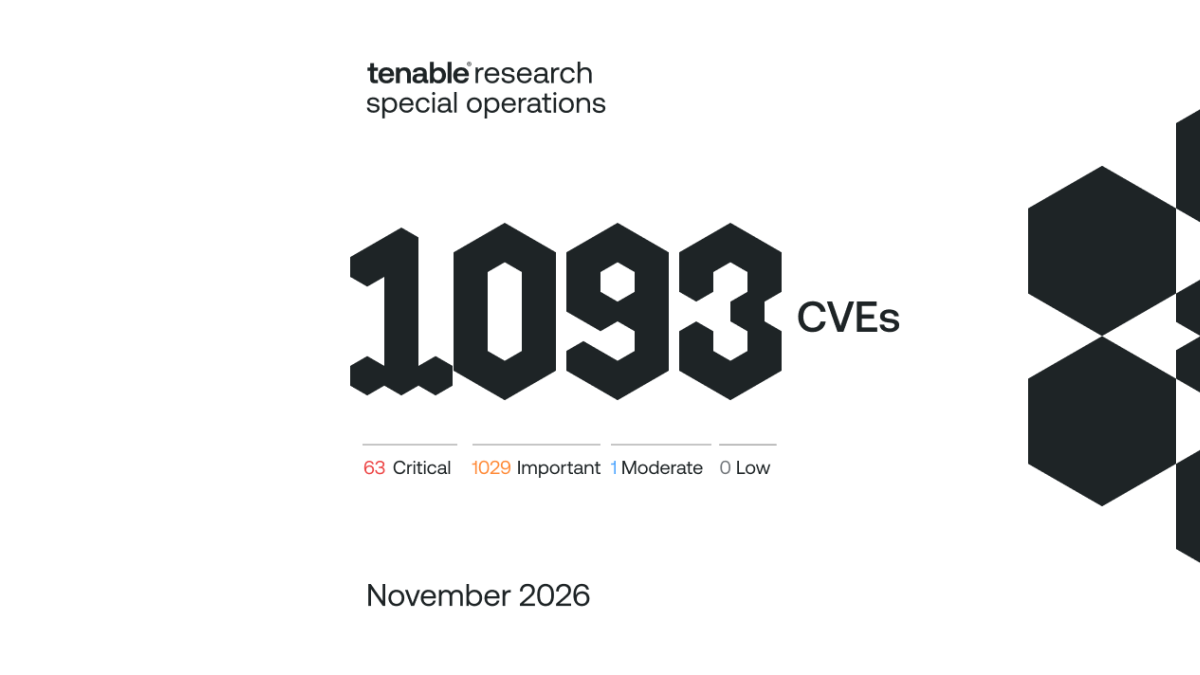
- 63Critical
- 1029Important
- 1Moderate
- 0Low
Microsoft addresses 1093 CVEs in the eleventh Patch Tuesday of 2026.
Microsoft patched 1093 CVEs in its November 2026 Patch Tuesday release, with 63 rated critical, 1029 rated as important, and one rated as moderate.

This month’s update includes patches for 287 products and components. The following table lists the products with the most CVEs patched this month. A full list of patched products is available in the appendix.
| Rank | Product | CVE Count |
|---|---|---|
| 1 | Microsoft Office Word | 65 |
| 2 | Microsoft Office Excel | 64 |
| 3 | SQL Server | 53 |
| 4 | Windows Advanced Rasterization Platform | 37 |
| 5 | Windows Installer | 36 |
| 6 | Windows Graphics Kernel | 35 |
| 7 | Windows Kernel | 28 |
| 8 | Microsoft Office SharePoint | 27 |
| 9 | Windows DNS | 22 |
| 10 (Tie) | Microsoft Office Outlook | 20 |
| 10 (Tie) | Windows Print Spooler Components | 20 |
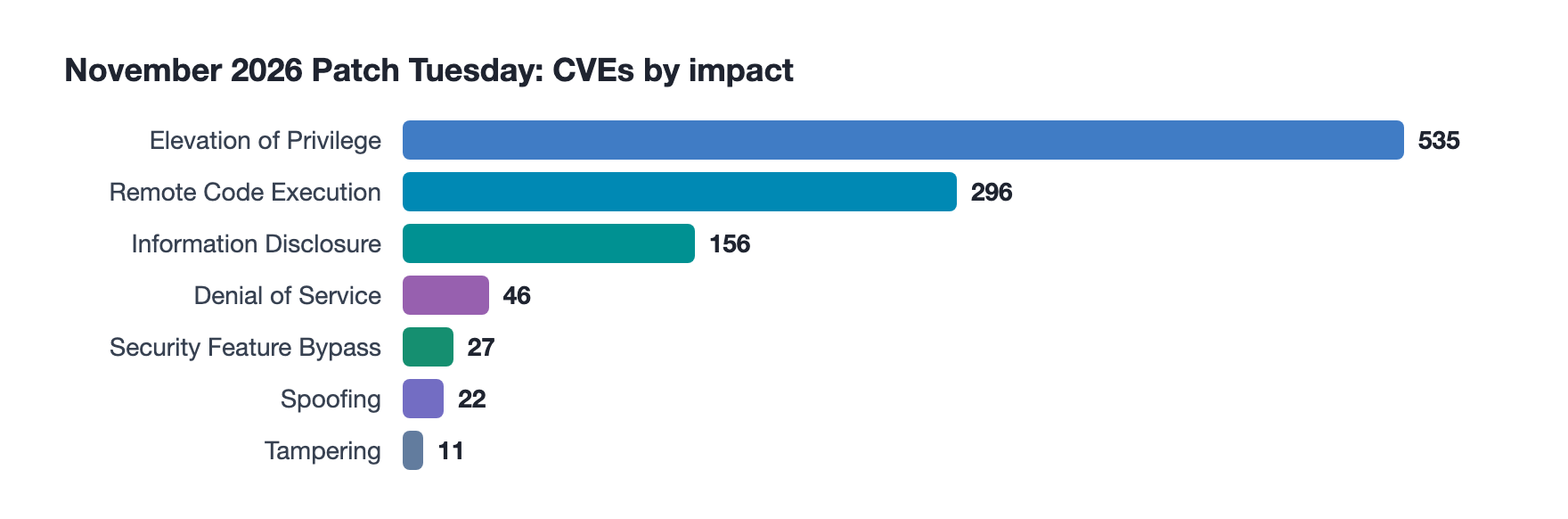
Elevation of Privilege (EoP) vulnerabilities accounted for 48.9% of the vulnerabilities patched this month, followed by remote code execution (RCE) vulnerabilities at 27.1%.
CVE-2026-124194 | Microsoft Outlook spoofing vulnerability
CVE-2026-124194 is a spoofing vulnerability in Microsoft Outlook. It received a CVSSv3 score of 6.5 and is rated moderate. An attacker could exploit this vulnerability by convincing a target to open a crafted Microsoft Office file. Successful exploitation would allow an attacker to obtain the target’s valid NTLMv2 hash, which can then be used to impersonate that user in follow-on attacks.
According to Microsoft, this vulnerability was exploited in the wild as a zero-day. Additionally, the advisory credits this discovery to a security researcher that used Claude, the large language model (LLM) from Anthropic, though no specific version of Claude was noted in the advisory.
CVE-2026-118146 | Windows Active Directory Domain Services remote code execution vulnerability
CVE-2026-118146 is an RCE vulnerability affecting Windows Active Directory Domain Services. It received a CVSSv3 score of 8.8 and is rated as critical. An authenticated attacker could exploit an incorrect authorization in Active Directory Domain Services to execute code over a network. Successful exploitation would allow an attacker to execute arbitrary code on the affected system. It was assessed as “Exploitation More Likely.”
CVE-2026-120002 | Microsoft SharePoint Server elevation of privilege vulnerability
CVE-2026-120002 is an EoP vulnerability affecting Microsoft SharePoint Server. It received a CVSSv3 score of 9.9 and is rated as important. An authenticated attacker could exploit an incorrect authorization in Microsoft Office SharePoint to elevate privileges over a network. Successful exploitation would allow an attacker to gain elevated privileges. It was assessed as “Exploitation Less Likely.”
CVE-2026-118207 | Microsoft Exchange Server remote code execution vulnerability
CVE-2026-118207 is an RCE vulnerability affecting Microsoft Exchange Server. It received a CVSSv3 score of 8.8 and is rated as critical. An authenticated attacker could send malformed input to Microsoft Exchange Server, causing code to execute over a network. Successful exploitation would allow an attacker to execute arbitrary code on the affected system. It was assessed as “Exploitation More Likely.”
CVE-2026-119952 | Windows Schannel remote code execution vulnerability
CVE-2026-119952 is an RCE vulnerability affecting Windows Schannel. It received a CVSSv3 score of 8.1 and is rated as critical. An unauthenticated attacker could exploit an observable timing discrepancy in Windows Schannel to execute code over a network. Successful exploitation would allow an attacker to execute arbitrary code on the affected system. It was assessed as “Exploitation More Likely.”
Additional Notable CVEs
The following CVEs also merit attention based on severity, exploitability, or CVSSv3 score:
| CVE | Product | Impact | CVSSv3 | Exploitability | Notes |
|---|---|---|---|---|---|
| CVE-2026-121663 | Visual Studio Code | Security Feature Bypass | 8.8 | Exploitation More Likely | Important |
| CVE-2026-121662 | Visual Studio Code | Remote Code Execution | 8.6 | Exploitation More Likely | Important |
| CVE-2026-113862 | Windows Network Address Translation (NAT) | Remote Code Execution | 8.1 | Exploitation More Likely | Critical |
| CVE-2026-105501 | Windows Installer | Elevation of Privilege | 7.8 | Exploitation More Likely | Important |
| CVE-2026-105524 | Windows Management Instrumentation | Elevation of Privilege | 7.8 | Exploitation More Likely | Important |
| CVE-2026-109473 | Windows Kernel | Elevation of Privilege | 7.8 | Exploitation More Likely | Important |
| CVE-2026-112811 | Windows Print Spooler Components | Elevation of Privilege | 7.8 | Exploitation More Likely | Important |
| CVE-2026-116714 | Windows AppX Deployment Service | Elevation of Privilege | 7.8 | Exploitation More Likely | Important |
| CVE-2026-119818 | Windows Text Services Framework | Elevation of Privilege | 7.8 | Exploitation More Likely | Important |
| CVE-2026-119853 | Remote Access API | Elevation of Privilege | 7.8 | Exploitation More Likely | Important |
| CVE-2026-119886 | Windows Telephony Service | Elevation of Privilege | 7.8 | Exploitation More Likely | Important |
| CVE-2026-119892 | Windows Installer | Elevation of Privilege | 7.8 | Exploitation More Likely | Important |
| CVE-2026-119903 | Windows Installer | Elevation of Privilege | 7.8 | Exploitation More Likely | Important |
| CVE-2026-83563 | Winlogon | Elevation of Privilege | 7.8 | Exploitation More Likely | Important |
| CVE-2026-88230 | Windows LUA File Virtualization Filter Driver | Elevation of Privilege | 7.8 | Exploitation More Likely | Important |
Additional CVEs addressed this month are listed in Microsoft’s Security Update Guide.
Tenable Solutions
A list of all the plugins released for Microsoft’s November 2026 Patch Tuesday update can be found here. As always, we recommend patching systems as soon as possible and regularly scanning your environment to identify those systems yet to be patched.
For more specific guidance on best practices for vulnerability assessments, refer to our blog post on How to Perform Efficient Vulnerability Assessments with Tenable.
Product Appendix
- .NET
- AMD Zen
- ASP.NET Core
- Active Directory Domain Services
- ActiveSyncProvider
- Aspire
- Azure CLI
- Azure Confidential Clean Rooms
- Azure CycleCloud
- Azure DevOps
- Azure DevOps Server
- Azure File Sync
- Azure Firmware
- Azure Front Door (AFD)
- Azure Local
- Azure Managed Grafana
- Azure NFS mount helper (aznfs)
- Azure OpenAI
- Azure Pipelines
- Connected Devices Platform Service (Cdpsvc)
- Data Deduplication
- Data Sharing Service Client
- Desktop Window Manager
- Github Copilot
- Graphic Fonts
- HEIF Image Extensions
- HID Parser Library
- HID class driver
- JDBC Driver for SQL Server
- Kernel Transaction Manager
- Mailslot File System
- Microsoft 365 Agents SDK
- Microsoft Account
- Microsoft ActiveX Installer Service
- Microsoft Authentication Library (MSAL) for Node.js
- Microsoft Authentication Library for JavaScript
- Microsoft Azure Kubernetes Service
- Microsoft Bluetooth Driver
- Microsoft Color Management
- Microsoft Configuration Manager
- Microsoft Defender
- Microsoft Dynamics 365 (on-premises)
- Microsoft Entra Private Network Connector
- Microsoft Exchange Server
- Microsoft Graph
- Microsoft Graphics Component
- Microsoft High Performance Computing (HPC) Pack
- Microsoft Input Method Editor (IME)
- Microsoft JScript
- Microsoft Local Security Authority Server (lsasrv)
- Microsoft MCP Gateway
- Microsoft Office
- Microsoft Office Access
- Microsoft Office Excel
- Microsoft Office Outlook
- Microsoft Office PowerPoint
- Microsoft Office SharePoint
- Microsoft Office Visio
- Microsoft Office Word
- Microsoft PowerShell
- Microsoft PowerShell Core
- Microsoft QUIC
- Microsoft Remote Registry Service
- Microsoft Streaming Service
- Microsoft Teams
- Microsoft Teams for Android
- Microsoft Trace Data Helper
- Microsoft WDAC OLE DB provider for SQL
- Microsoft Windows App Store
- Microsoft Windows Codecs Library
- Microsoft Windows Media Foundation
- Microsoft Windows SCSI Class System File
- Microsoft Windows Search Component
- Microsoft Windows Speech
- Microsoft XPS Document Converter
- Quality Windows Audio/Video Experience (QWAVE) service
- RPC Runtime
- Reliable Multicast Transport Driver (RMCAST)
- Remote Desktop Client
- Remote Desktop Gateway Service
- Role: DNS Server
- SQL Server
- Secondary Logon
- Servicing Stack Updates
- Software Protection Platform (SPP)
- Storport.sys Driver
- Virtual Hard Disk (VHD) Miniport Driver
- Visual Studio
- Visual Studio Code
- Visual Studio Code - GitHub Pull Requests and Issues Extension
- Windows Active Directory
- Windows Active Directory Certificate Services
- Windows Admin Center
- Windows Advanced Rasterization Platform
- Windows Ancillary Function Driver for WinSock
- Windows App Readiness Service
- Windows AppContainer
- Windows AppX Deployment Service
- Windows AppX Package Manager
- Windows Audio Service
- Windows Autopilot
- Windows Background Intelligent Transfer Service (BITS)
- Windows Backup Engine
- Windows Bind Filter Driver
- Windows Biometric Service
- Windows BitLocker
- Windows Bluetooth A2DP driver
- Windows Bluetooth Port Driver
- Windows Bluetooth Service
- Windows Broadcast DVR User Service
- Windows Broker Infrastructure Service
- Windows Brokering File System
- Windows CD-ROM Driver
- Windows CNG Key Isolation Service
- Windows COM
- Windows COM+ Event System Service
- Windows Camera Frame Server Monitor
- Windows Client for NFS
- Windows Clipboard Virtual Channel Extension
- Windows Cloud Files Mini Filter Driver
- Windows Composite Image File System
- Windows Connected User Experiences and Telemetry
- Windows Connection Manager Service
- Windows Container Isolation FS Filter Driver (unionfs.sys)
- Windows Container Manager Service
- Windows Cred SSProvider Protocol
- Windows Credential Manager
- Windows Credential User Interface
- Windows DHCP Client
- Windows DHCP Server
- Windows DIAL Client
- Windows DNS
- Windows DPAPI (Data Protection Application Programming Interface)
- Windows DWM Core Library
- Windows Defender Firewall Service
- Windows Deployment Services
- Windows Device Association Service
- Windows Device Inventory
- Windows Devices Human Interface
- Windows Diagnostic Policy Service
- Windows DirectX
- Windows Distributed File System (DFS)
- Windows Distributed Transaction Coordinator
- Windows Encrypting File System (EFS)
- Windows Enhanced Storage
- Windows Error Reporting
- Windows Event Collector Service
- Windows Event Logging Service
- Windows Event Viewer
- Windows FTP Service
- Windows Failover Cluster
- Windows Fast FAT Driver
- Windows Feedback Hub
- Windows File Server Resource Management Service
- Windows FileCrypt Driver
- Windows Filter Manager
- Windows Filtering Platform (WFP)
- Windows Function Discovery Resource Publication
- Windows Function Discovery SSDP Provider
- Windows GDI
- Windows Graphics Kernel
- Windows HTTP.sys
- Windows Hyper-V
- Windows IKE Extension
- Windows IP Translation Configuration Service
- Windows Image Acquisition
- Windows Imaging Component
- Windows Input System
- Windows Installer
- Windows Internet (wininet.dll)
- Windows Internet Connection Sharing (ICS)
- Windows Internet Information Services
- Windows Inventory Backup
- Windows Kerberos
- Windows Kernel
- Windows Kernel-Mode Drivers
- Windows LDAP - Lightweight Directory Access Protocol
- Windows LUAFV
- Windows Language Experience Service
- Windows Layer-2 Bridge Network Driver
- Windows Link Layer Topology Discovery Protocol
- Windows Link-Layer Discovery Protocol (LLDP)
- Windows Local Security Authority Subsystem Service (LSASS)
- Windows Local Session Manager (LSM)
- Windows MIDI Service Module
- Windows Management Instrumentation
- Windows Management Services
- Windows Maps
- Windows Media Player
- Windows Message Queuing
- Windows Message Queuing Queue Manager
- Windows Microsoft Account Sign-in Assistant
- Windows Microsoft DirectMusic
- Windows Mobile Device Management
- Windows Modern Device Management (MDM)
- Windows Multiple Provider Router
- Windows NTFS
- Windows NTLM
- Windows NetBIOS
- Windows Network Address Translation (NAT)
- Windows Network Connected Devices Auto-Setup Service
- Windows Network Connection Broker
- Windows Network File System
- Windows ODBC Driver
- Windows OLE
- Windows OLE DB
- Windows Overlay Filter
- Windows PCI Bus Driver
- Windows Partition Management Driver
- Windows Performance Counters
- Windows Performance Monitor
- Windows Phone Service
- Windows Point-to-Point Protocol over Ethernet (PPPoE)
- Windows PowerShell
- Windows Print Spooler Components
- Windows PrintWorkflowUserSvc
- Windows Program Compatibility Assistant Service
- Windows Projected File System
- Windows Projected File System Filter Driver
- Windows Push Notification Core
- Windows Push Notifications
- Windows RNDIS
- Windows Raw Image Extension
- Windows Redirected Drive Buffering
- Windows Remote Access API
- Windows Remote Access Connection Manager
- Windows Remote Assistance
- Windows Remote Desktop
- Windows Remote Desktop Services
- Windows Remote Procedure Call
- Windows Remote Procedure Call Runtime
- Windows Resilient File System (ReFS)
- Windows Rich Text Edit Control
- Windows SMB
- Windows SMB Client
- Windows SMB Server
- Windows SMB Server Network Transport Driver (srvnet.sys)
- Windows SSDP Service
- Windows Sandbox
- Windows Schannel
- Windows Secure Kernel Mode
- Windows Secure Socket Tunneling Protocol (SSTP)
- Windows Security Account Manager
- Windows Security Center
- Windows Sensor Data Service
- Windows Server for NFS
- Windows Setup and Deployment
- Windows Shell
- Windows Smart Card
- Windows State Repository Service
- Windows StateRepository API
- Windows Storage
- Windows Storage Spaces Controller
- Windows Storport Miniport Driver
- Windows Subsystem for Linux
- Windows System Events Broker
- Windows TCP/IP
- Windows TPM
- Windows Task Scheduler
- Windows Telephony Service
- Windows Text Services Framework
- Windows USB Audio Class driver (usbaudio.sys)
- Windows USB Driver
- Windows USB Hub Driver
- Windows USB Scanner Driver
- Windows USB Video Driver
- Windows USM Communication Manager
- Windows Universal Disk Format File System Driver (UDFS)
- Windows Update Stack
- Windows User Manager Service
- Windows VMSwitch
- Windows Virtual Filtering Platform (VFP)
- Windows Volume Shadow Copy
- Windows WLAN Service
- Windows Win32K
- Windows WinHTTP
- Windows Wireless Networking
- Windows XWizard Framework
- Windows Xbox Live Networking Service
- Windows eSCL Scanner
- Windows exFAT File System
- Windows iSCSI
- Windows iSCSI Target Service
- Winlogon
- Winsock
- Xbox
- vhdmp.sys
Get more information
Learn more

Learn more
Related articles


- Exposure Management
- Vulnerability Management
Tenable One
Request a demo
The world’s leading AI-powered exposure management platform.
Thank You
Thank you for your interest in Tenable One.
A representative will be in touch soon.
Form ID: 7469
Form Name: one-eval
Form Class: c-form form-panel__global-form c-form--mkto js-mkto-no-css js-form-hanging-label c-form--hide-comments
Form Wrapper ID: one-eval-form-wrapper
Confirmation Class: one-eval-confirmform-modal
Simulate Success